

Why Hard Work Isn’t Always Smart Work
Most people think that grinding harder leads to success, but let’s be real that’s nonsense. More hours don’t always mean more progress, in fact, plenty of high achievers are unknowingly sabotaging themselves with habits that drain their energy, waste their time and scatter their focus.
The real trick? Deep work, automation, saying “no” more often and ruthless prioritisation.
After years of fine-tuning my own workflow (and helping businesses do the same), I’ve noticed one thing: the ones who thrive aren’t necessarily the ones working the longest hours, they’re the ones who work smarter, sharper and with laser focus.
So, let’s break it down. What actually makes or breaks productivity?
Work Habits That Actually Get Things Done
Deep Work That Actually Works
What it is: Blocking out uninterrupted, high-focus time to properly get stuck into meaningful work.
Why it works: Instead of jumping between distractions, deep work lets you tackle complex tasks, make strategic decisions and actually finish what you start.
How to do it:
Time block like a pro: set dedicated slots for high-impact work.
Mute the noise: notifications, emails and social media can wait.
Go in with a plan: don’t just “work” decide exactly what you’ll get done.
Real-World Example:
I worked with a handmade business owner who was drowning in admin, constantly answering messages, reacting to every notification and struggling to focus. We automated inquiries, structured work hours and prioritised deep work. The result? More time, more creativity and actual business growth.
Automate or Delegate the Repetitive Stuff
What it is: Using automation and AI to take mindless, repetitive tasks off your plate.
Why it works: Instead of manually handling every email, spreadsheet update or customer query, let tech do the heavy lifting so you can focus on real work.
How to do it:
Put boring tasks on auto-pilot, set up automated responses, invoicing and social media scheduling.
Use AI for insights, ditch manual spreadsheets and let data-driven tools do the number crunching.
Let chatbots handle FAQs, free up hours by letting bots answer the same five questions customers always ask.
Real-World Example:
An e-commerce client was wasting hours every day on emails, customer inquiries and stock management, by automating emails and inventory tracking, we cut wasted time by 60%, freeing up space for strategy, creativity and business expansion.
Saying No (A Lot More Often)
What it is: Ditching the time-wasters and focusing on what actually moves the needle.
Why it works: You can’t do everything and you shouldn’t even try, saying no to distractions, pointless meetings and low-value tasks protects your time and energy for what actually matters.
How to do it:
Audit your to-do list, ditch anything that doesn’t drive real results.
Batch similar tasks, so you’re not constantly switching between different types of work.
Be ruthless with your time, if it doesn’t serve your goals it’s a no.
Real-World Example:
I’ve used the 80/20 rule for years, focusing only on the 20% of tasks that bring 80% of results, batching similar work and eliminating pointless commitments. The result? More progress, less stress and fewer wasted hours.
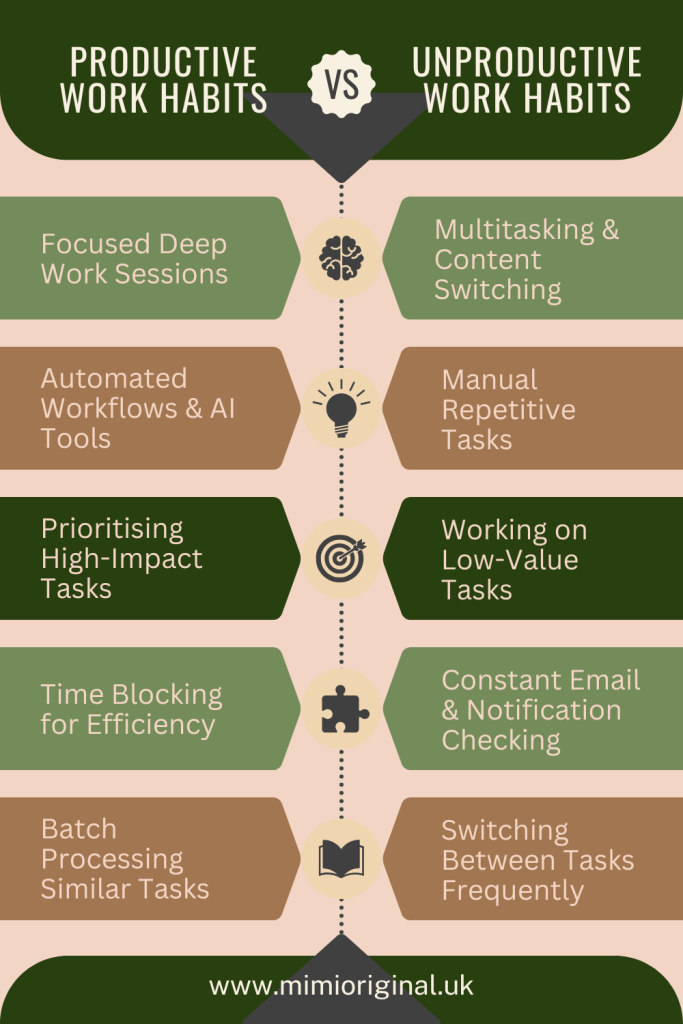
Productivity Killers You Need to Drop
Multitasking & Context Switching
Why it’s a nightmare:
- Your brain isn’t built for it, you lose focus every time you switch tasks.
- It drains mental energy and slows you down instead of speeding you up.
Fix it:
One thing at a time, single-tasking is your friend.
Batch similar tasks together, so your brain doesn’t have to keep resetting.
Notifications & Digital Overload
Why it’s killing your focus:
- Every “ping” pulls you out of deep work and makes it harder to get back in.
- It takes 23 minutes to fully regain focus after being interrupted, that’s a lot of lost time.
Fix it:
Mute notifications, turn off the noise when you’re working.
Check emails/messages at set times, instead of responding all day long.
Pointless, Unstructured Meetings
Why they waste time:
- Most meetings could be an email (but we all know that one person who loves to waffle…).
- No agenda? No clear purpose? It’s a time vortex.
Fix it:
Short, structured meetings only with clear objectives.
Set time limits if it’s dragging past 30 minutes rethink it.
My Take on Productivity: Work Less, Achieve More
When things get overwhelming, I don’t “push through”, I reset.
Most people force themselves to keep going when they’re burnt out, frustrated or stuck, but that just leads to exhaustion, bad decisions and zero motivation.
Instead I shut everything down, take a break and reset properly. When I come back, I’ve got fresh energy, sharper focus and a solid plan.
Sounds counterintuitive? Maybe, but trust me – it works.
The Bottom Line: Work Smarter, Not Longer
Productivity isn’t about doing more, it’s about doing what actually matters.
Deep work, automation and saying no = real progress.
Multitasking, distractions and endless meetings = productivity killers.
Reset when needed, sometimes, stopping is the smartest move you can make.
Your Turn: What’s Your #1 Productivity Trick?
Now, let’s hear from you!
🔸What’s one unproductive habit you’ve kicked to the curb?
🔸What’s your biggest game-changer when it comes to getting things done?
Drop your thoughts in the comments!
Let’s swap ideas and build better work habits together.




 Unlearn Adapt Lead: Build Your Dream
Leave a comment